

Menu
Public Charge in 2026 - Why the Same Green Card Case Can Be Judged Differently at USCIS vs. a U.S. Consulate
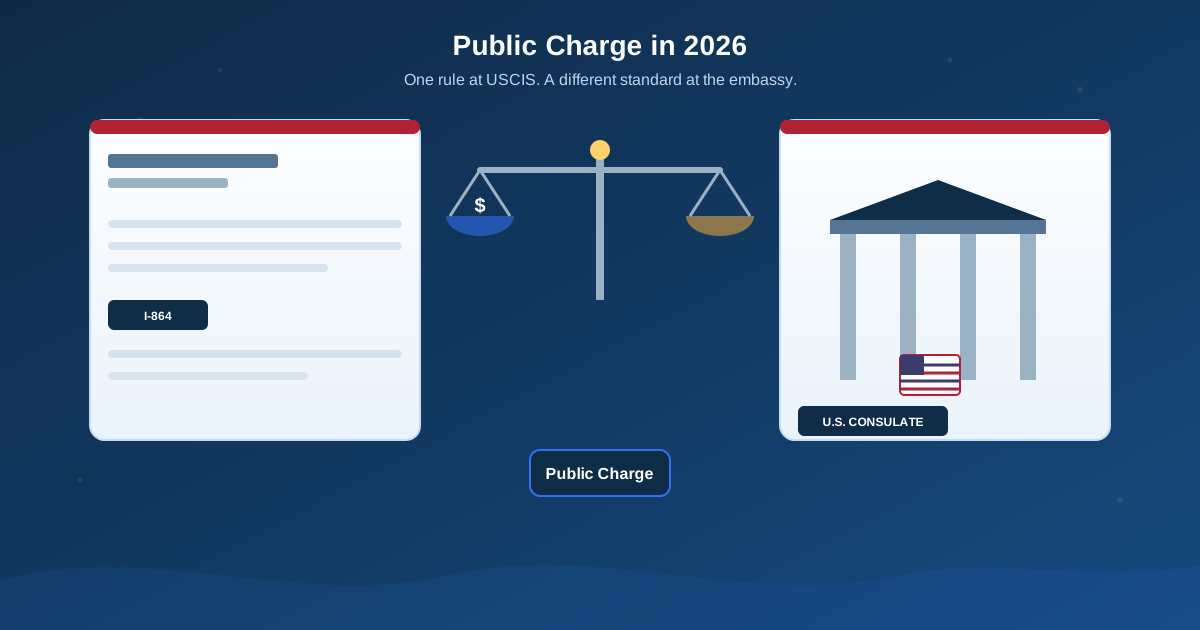
Public Charge in 2026: Why the Same Green Card Case Can Be Judged Differently at USCIS vs. a U.S. Consulate
"Public charge" has been part of U.S. immigration law for well over a century, but in 2026 it is being applied in two noticeably different ways depending on where your case is decided. If you are pursuing a green card or immigrant visa this year, understanding which standard applies to you — and why — matters a great deal.
What Is "Public Charge," in Plain Terms?
Public charge is a ground of inadmissibility. In deciding whether to approve certain green card and visa applications, the government is required to assess whether the applicant is likely to become primarily dependent on the government for financial support in the future — for example, through long-term cash assistance or institutionalized long-term care paid for by the government.
It is not about whether you have ever used any public benefit. It is a forward-looking judgment about self-sufficiency.
The Split in 2026: Two Different Standards
Here is the part that surprises a lot of applicants and even some employers of legal help: the rule your case is evaluated under can depend on whether you are applying inside the United States or at a U.S. consulate abroad.
Inside the U.S. — USCIS
For adjustment of status applications filed with USCIS, the agency is currently still applying the 2022 public charge final rule. That rule uses a "totality of the circumstances" test but is generally considered narrower and more predictable than what came before it. As of mid-2026, this remains the governing, currently effective rule for USCIS cases — even though the administration has proposed rescinding it.
Outside the U.S. — U.S. Consulates
For immigrant and nonimmigrant visa applicants going through consular processing abroad, the U.S. Department of State has issued its own updated guidance — most recently refreshed in February 2026 — that consular officers are applying with renewed attention across visa categories. This guidance directs officers to weigh a broader set of factors, including:
- Financial resources — income, assets, liabilities, and overall financial stability (typically the most heavily weighted factor)
- Education and skills — stronger credentials and marketable skills are viewed favorably
- Age — officers may give more scrutiny to applicants nearing retirement age with limited income
- Health — significant medical conditions that could require long-term, government-funded care are a relevant factor, though a health condition alone does not automatically create a problem
- Family status — household size and the financial obligations that come with it
- Past or current use of U.S. public benefits
In short: two applicants with similar profiles could reasonably expect different levels of scrutiny depending purely on whether their case is being decided by USCIS domestically or by a consular officer overseas.
A Rule Change Is Proposed — But Not Yet in Effect
In late 2025, the government issued a proposed rule intended to rescind the 2022 USCIS public charge rule and replace it with a standard that gives officers considerably more discretion. Under the proposed approach, factors like age, health conditions, and even weight have been specifically discussed as relevant considerations, with applicants aged 65 and older flagged as a "highly negative factor" due to potential long-term care costs.
This is a proposed rule, not current law. It has not been finalized or implemented by USCIS as of this writing. Until it is, the 2022 rule remains the operative standard for USCIS adjustment of status cases. That said, given how quickly immigration policy has been moving in 2026, applicants and their attorneys should not assume this will remain true indefinitely.
Who This Matters Most For
This distinction is especially important if you are weighing adjustment of status versus consular processing — a choice that comes up constantly in family-based and marriage-based green card cases. If your case could realistically go either route, the current gap between the USCIS standard and the consular standard is a factor worth discussing with an attorney before you choose a path.
It also matters for:
- Family members being sponsored from abroad who will interview at a U.S. embassy or consulate
- Petitioners preparing the Form I-864 Affidavit of Support, which remains central to overcoming public charge concerns under either standard
- Anyone with a complex financial picture, a significant health condition, or an older applicant in the household
How to Strengthen Your Case Under Either Standard
- Build a thorough Affidavit of Support. Whether your case is decided domestically or abroad, a well-documented I-864 showing income at or above 125% of the federal poverty guideline — supported by tax returns, pay stubs, and employment verification — is the foundation of a strong public charge showing.
- Document assets and education, not just income. Savings, property, and professional qualifications all speak to self-sufficiency.
- Be thoughtful about timing benefits use. Understand which programs are actually considered under public charge analysis (the list is narrower than most people assume) before making assumptions about what could hurt your case.
- If a joint sponsor is needed, line one up early. Do not wait until an RFE or consular request forces the issue.
- Get case-specific advice before choosing between adjustment of status and consular processing if both are realistically available to you.
Why Work With an Immigration Attorney
Public charge analysis is fact-specific, and in 2026 it is also standard-specific depending on where your case is filed. A case that would sail through under one standard could face real scrutiny under the other. Getting this assessment wrong — or filing without understanding which rule applies — can mean unnecessary delay or a denial that was avoidable.
At Ragheb Immigration Law, we help clients throughout Tampa Bay evaluate public charge risk before filing, build strong supporting documentation, and choose the filing strategy that gives their case the best chance of success under the rules currently in effect.
Talk to Us Before You File
If you are preparing a green card or immigrant visa application and want to understand how public charge considerations apply to your specific situation, contact our office for a consultation. We stay current on these fast-moving rules so you do not have to guess.
Tags
- Public Charge 2026
- Green Card Eligibility
- Affidavit of Support
- Consular Processing
- Adjustment of Status
- Family Immigration
- Tampa Immigration Lawyer